5 Revenue Operations Problems That AI Agents Solve
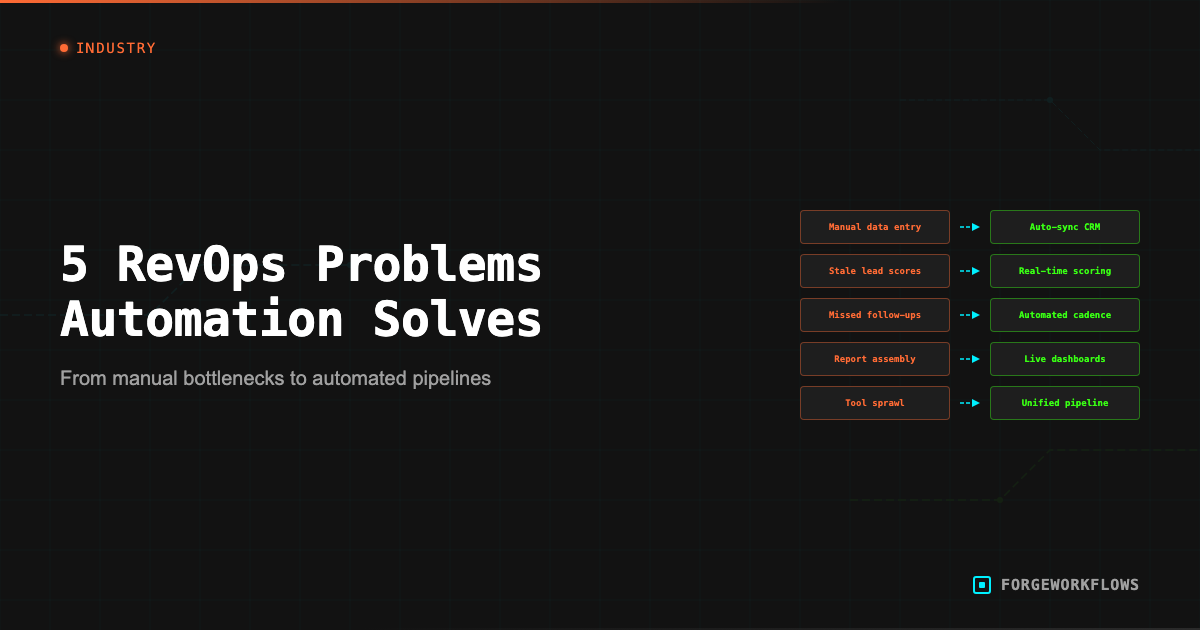
The RevOps Bottleneck
Revenue Operations teams sit at the intersection of sales, marketing, and customer success. Their job is to make the revenue engine run - which means they are responsible for pipeline accuracy, forecasting, data quality, rep performance, and competitive positioning. All at once. With data scattered across 5-10 systems.
The problem is not a lack of data. Most B2B organizations have more data than they can process. The problem is that turning that data into actionable intelligence requires analysis - the kind of contextual, judgment-heavy analysis that does not reduce to a dashboard filter or a SQL query.
This is where agentic workflows change the equation. An agent can read CRM data, apply a reasoning framework, and produce a structured brief - the same work a RevOps analyst would do manually, but executed consistently, on schedule, for every record. Not a replacement for the analyst, but a force multiplier that handles the repetitive analysis so the human can focus on strategy. Each Blueprint is BQS-certified and ITP-tested before listing, so the analysis quality is verified, not assumed.
Here are the five most persistent RevOps problems and how specific ForgeWorkflows Blueprints address each one.
Problem 1: Pipeline Forecasting
Pipeline forecasting is the RevOps team most visible responsibility - and its most common failure mode. The standard approach: reps update deal stages and close dates in the CRM, a manager applies a weighted probability to each stage, and the resulting number becomes "the forecast." The problem is that this number is wrong more often than it is right.
Why forecasts fail:
- Stale data. Reps do not update deal stages in real time. A deal that moved to negotiation last week might still be listed as "demo scheduled" in the CRM.
- Uniform probability. Applying the same win probability to every deal in a stage ignores deal-specific signals (champion engagement, competitive pressure, budget timeline).
- Single-point estimates. A forecast is a number, but the actual outcome is a range. Without confidence intervals, the forecast gives false precision.
The RevOps Forecast Intelligence Agent addresses this by pulling the entire HubSpot pipeline weekly and applying multi-factor analysis to each deal. Instead of stage-based probability, the agent scores each deal on activity recency, stakeholder engagement, competitive signals, and historical patterns. The output is a forecast brief with deal-level risk flags - not just a number, but the reasoning behind the number.
Browse RevOps Blueprints at /blueprints/team/revops.
The RevOps Forecast Intelligence Agent runs weekly and produces a pipeline risk brief with deal-level scores. It replaces the manual spreadsheet analysis, not the human judgment that acts on it.
Problem 2: Deal Stall Detection
Deals stall for many reasons: champion left, budget got cut, competitor entered, legal review is stuck, or the prospect simply went quiet. The CRM shows none of this nuance - it just shows a deal that has not changed stage in 14 days.
The manual approach to stall detection: a manager reviews the pipeline once a week, eyeballs which deals have not moved, and pings reps for updates. This is slow, subjective, and scales poorly. With 50+ active deals, the manager cannot analyze each one in depth.
The Deal Stall Diagnoser automates the diagnosis. It reads the full deal history from the CRM - activities, notes, stage changes, last contact date - and applies a diagnostic framework. The output is not "this deal has not moved in 14 days" (you can get that from a CRM filter). The output is "this deal stalled after the pricing discussion on March 3rd, the champion has not responded to two follow-ups, and similar deals in this pattern have a 30% close rate." That is analysis, not alerting.
The Blueprint runs on a schedule (typically weekly) and produces a diagnostic brief for every stalled deal. The brief includes: stall pattern classification, contributing factors, recommended next action, and comparable historical outcomes.
Problem 3: CRM Data Decay
CRM data decays constantly. People change jobs, companies rebrand, phone numbers change, email addresses bounce. Industry estimates suggest 20-30% of B2B contact data degrades annually. For a RevOps team, bad data means bad forecasts, bad routing, and wasted outreach effort.
The traditional fix: periodic manual audits or batch data enrichment services. Manual audits are expensive and infrequent. Batch enrichment services update fields but do not assess the overall health of a contact record or flag records that need human attention.
The CRM Data Decay Detector runs weekly against your Pipedrive contacts and audits data quality across 5 categories: contact completeness (are key fields filled?), activity recency (when was the last interaction?), role validity (is the job title still current?), email deliverability signals, and phone number format. Each contact gets a decay score, and the output is a prioritized list of records that need attention.
This is not a one-time cleanup - it is ongoing hygiene. Running weekly means you catch decay early, when a single field update fixes the record, rather than discovering 6 months later that half your database is stale.
For the product guide, see the CRM Data Decay Detector guide.
Problem 4: Rep Performance Coaching
Sales managers are supposed to coach their reps. In practice, coaching happens sporadically - during quarterly reviews, after a lost deal, or when a rep asks for help. The data to support coaching exists (activity metrics, win rates, deal velocity, pipeline coverage) but synthesizing it into actionable coaching insights for each rep is a manual analysis task that most managers do not have time for.
The Sales Rep Performance Coach generates weekly coaching briefs for every rep on the team. It pulls activity data, deal outcomes, and pipeline metrics from the CRM, then produces a brief that covers: what the rep is doing well, what needs attention, specific deals to focus on, and suggested actions for the coming week.
The brief is not a performance review - it is a coaching tool. It is designed to give the manager a starting point for a 10-minute 1:1 conversation, not a comprehensive evaluation. The value is consistency: every rep gets weekly analysis, not just the ones who are visibly struggling or visibly succeeding.
The agent applies the same analytical framework to every rep, which also helps identify team-wide patterns. If three reps all show declining activity on Fridays, that is a process issue, not an individual coaching issue. The weekly briefs make these patterns visible.
The Sales Rep Performance Coach produces coaching input, not coaching output. The manager still has the conversation. The Blueprint gives them data-backed starting points for that conversation.
Problem 5: Competitive Intelligence
Every B2B sales team needs competitive intelligence, and few have a systematic process for gathering and distributing it. The typical pattern: a rep encounters a competitor in a deal, mentions it in a Slack thread, and the information evaporates. There is no centralized view of which competitors appear in which deals, what their positioning is, or how win rates change when specific competitors are involved.
The Competitive Pricing Intelligence Blueprint monitors pricing changes and competitive signals on a weekly schedule. It produces battle cards - structured briefs for each competitor that include: pricing comparison, positioning differences, common objections, and suggested talk tracks.
The Deal Competitor Tracker takes a deal-specific approach: when a deal is flagged as competitive, the agent researches the competitor, generates a battle card for that specific deal context, and posts it to the deal record in the CRM. The rep gets competitive intelligence before their next call, not after they have already lost.
Both Blueprints address the same root problem: competitive intelligence is only useful if it reaches the rep at the moment they need it. A quarterly competitive analysis deck is too late. A deal-level battle card delivered to Slack before the next call is on time.
Browse all RevOps Blueprints at /blueprints/team/revops and sales Blueprints at /blueprints/team/sales.
Frequently Asked Questions
What specific RevOps problems can agentic workflows address?+
The five core problems are inaccurate pipeline forecasting, stalled deals without timely intervention, CRM data decay from manual entry, inconsistent rep coaching, and slow competitive intelligence gathering. Each of these has a corresponding workflow pattern that automates the analysis and routing.
Do these workflows replace RevOps team members?+
No. These workflows handle the repetitive data processing, scoring, and alerting that consume analyst time. RevOps team members focus on strategy, interpretation, and decision-making. The workflow surfaces the right information at the right time — humans act on it.
How quickly can a RevOps team see results from deploying an agentic workflow?+
Most teams report measurable impact within the first two weeks of deployment. CRM hygiene improvements show up immediately as the workflow flags stale records. Forecast accuracy and deal velocity improvements take one to two pipeline cycles to become visible in reporting.