Autonomous SDR Blueprint
32-node agentic swarm that researches, qualifies, writes, and syncs — so your SDR team focuses on closing.
A production-grade n8n workflow that automates the complete SDR pipeline: deep research via web intelligence, multi-criteria lead qualification with Chain-of-Thought reasoning, hyper-personalized email drafting, and CRM synchronization. Tested against 22 leads across 6+ verticals. Blueprint Quality Standard (BQS) v2 certified. We built this after watching a sales team spend 4 hours per day manually researching leads that a 5-agent pipeline could qualify in seconds. The conditional gate that kills low-scoring leads before email drafting was the design decision that made the per-lead cost viable.
Last updated February 25, 2026
B2B sales teams spend 65% of their time on non-selling activities, with manual lead qualification consuming the largest share. As contact databases grow past 10K records and buying committees expand to 6-10 stakeholders, human-only qualification cannot keep pace. Automated scoring with transparent, auditable criteria lets reps focus on conversations instead of spreadsheets.
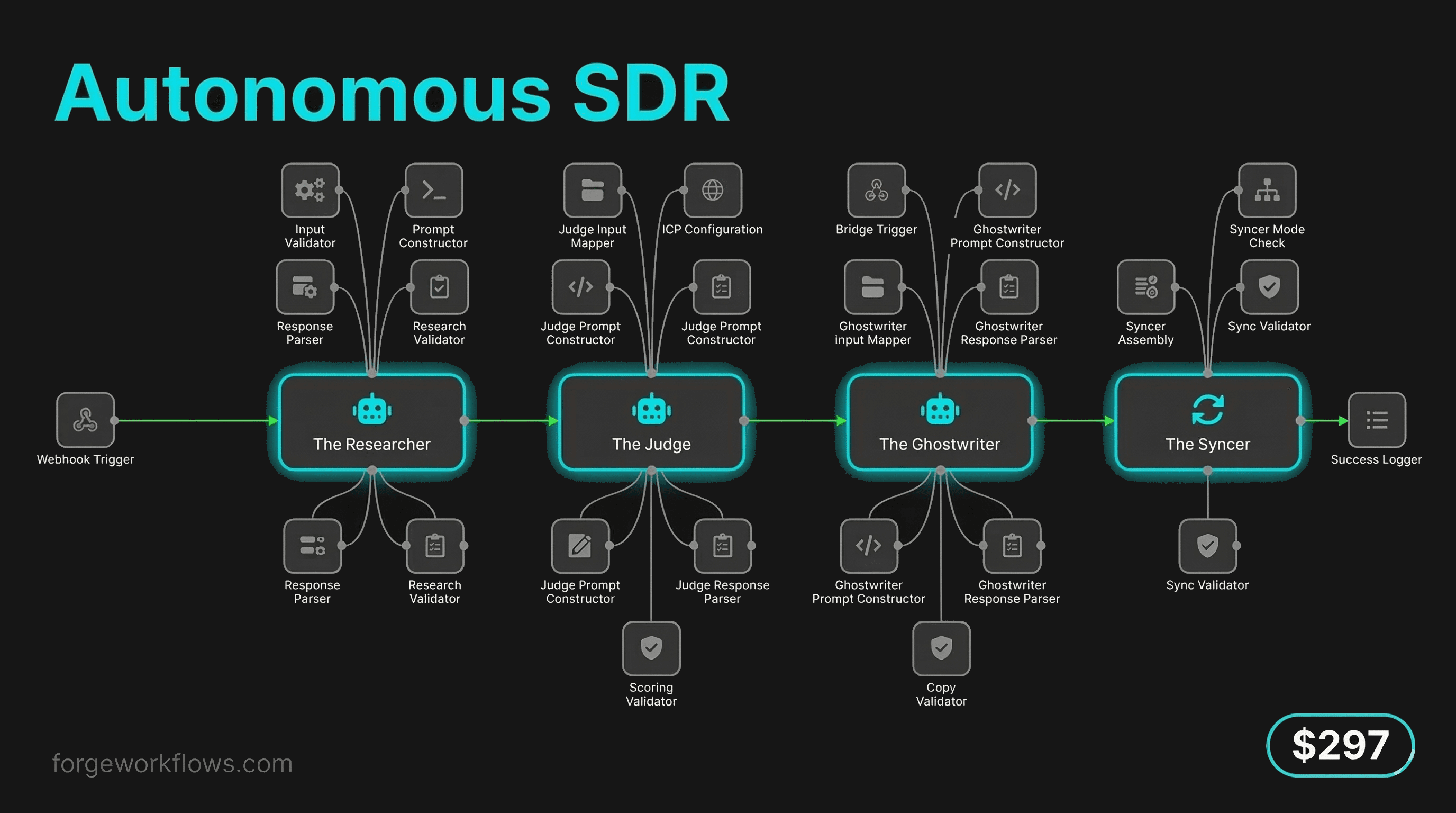
Four Agents. One Pipeline. Zero Manual Steps.

Step 1 — The Researcher
Web Intelligence
Pulls deep context from live web sources. Not a simple company lookup — the Researcher synthesizes recent activity, identifies pain points, and surfaces trigger events your SDR would spend 15 minutes finding manually.

Step 2 — The Judge
Reasoning (Tier 1)
What does The Judge actually decide? Five-criteria scoring engine: ICP fit, technographic compatibility, intent signal, budget authority, and urgency. Each criterion scored independently with explicit reasoning before a composite Lead Utility Score is assigned. The LUS ≥ 7 threshold is the deterministic bridge — only qualified leads proceed.

Step 3 — The Ghostwriter
Creative (Tier 3)
This step exists because raw data alone is not enough. No 'I hope this finds you well.' The Ghostwriter crafts emails that reference specific research findings — the trigger events, recent news, or problem signals the Researcher surfaced. Every email is constrained to 3 sentences with a direct call-to-action.

Step 4 — The Syncer
Delivery
Without this step, upstream analysis sits idle. Bearer token authentication. Structured payload mapping. Response confirmation logged. If the sync fails, retry with backoff — and if all retries fail, the record is quarantined in a dead letter log, never silently dropped.Our first SDR used a flat 3-agent architecture. Splitting into discrete agents with handoff contracts cut processing time and made each agent independently testable.
That's the full pipeline. Here's what it intentionally does NOT do — and why those boundaries exist.
What It Does NOT Do
Does not source leads — you provide a CSV or connect to your existing lead database
Does not manage email warmup or domain reputation — use your sending platform's warmup tools
Does not guarantee deliverability — outreach quality depends on your domain health and sending infrastructure
Does not replace CRM workflows — the Syncer writes to your outbound platform, not your CRM pipeline
With those boundaries clear, here's everything that ships when you purchase.
The Complete Customer Success Bundle
9 files.
The technical specifications below are ITP-measured, not estimated.
Tested. Measured. Documented.
All values below are from Independent Test Protocol (ITP) testing — not estimates, not projections. Measured across 22 test records spanning 6+ industry verticals.
Workflow Nodes
32
Blueprint Quality Standard
12/12 PASS
Agent Roles
4 (Researcher, Judge, Ghostwriter, Syncer)
Bundle Files
9
Test Coverage
22 across 6+ verticals
Inspection & Test Plan
16/16 PASS
n8n Versions Tested
2.7.5 / 2.8.3
Avg Processing Time
48 seconds
Cost per Filtered Lead
$0.02
Cost per Qualified Lead
$0.24
Tested on n8n v2.7.5, March 2026
Autonomous SDR v1.0.0 — Technical Reference━━━━━━━━━━━━━━━━━━━━━━━━━━━━━━━━━━━━━━━━━━━━━━Pipeline: Webhook → Researcher → Judge → Bridge (LUS ≥ 7) → Ghostwriter → SyncerTopology: Modular Agentic Swarm (4 agents)Reasoning: Chain-of-Thought 5-criteria scoring (ICP fit, technographic, intent, budget, urgency)Node Count: 32LLM: Claude Sonnet 4.5 (Researcher) + Claude Opus 4.6 (Judge) + Claude Haiku 4.5 (Ghostwriter)Cost: $0.24/qualified lead | $0.02/filtered leadITP: 22 records across 6+ verticals, 16/16 milestones PASSBQS: 12/12 PASSProcessing: 48 seconds averageTool A: Instantly (outbound email delivery)Tool B: Web Search (lead research)
What You'll Need
⚠ Data Source Dependency
This blueprint uses Anthropic's managed web search tool to research contacts and companies. Search results depend on live web data and may vary.
Platform
n8n 2.11.2+
Est. Monthly API Cost
$5–25/month depending on lead volume
Credentials Required
- ▪Anthropic API
- ▪Instantly API
Services
- ▪Instantly account
Setup Track
Quick Start
~15 min
All credentials live, n8n running
Full Setup
1–2 hrs
Needs API config + tables
From Scratch
2–4 hrs
No n8n, no credentials
Autonomous SDR Blueprint v1.0.0
$297
one-time purchase
What you get:
- ✓32-node n8n workflow (.json) — you own it
- ✓3 tested agent system prompts (ITP-validated)
- ✓10-Minute README quickstart guide
- ✓Error handling matrix (40 failure modes documented)
- ✓Dependency matrix with cost estimates
- ✓ICP scoring configuration template
- ✓All sales final after download
Frequently Asked Questions
What do I need to run this blueprint?+
An n8n instance (self-hosted or cloud), an Anthropic API key, and an outbound email platform account (Instantly V2 recommended). The dependency matrix in the bundle lists every required service with estimated costs and sign-up links. Total operating cost is approximately $0.24 per qualified lead.
How long does setup take?+
The README is designed for a 10-minute setup. Import the workflow JSON into n8n, configure your API credentials, customize the ICP scoring criteria for your target market, and run a test lead. During ITP testing, a CTO walkthrough completed in under 2 minutes.
Can I customize the lead scoring criteria?+
Yes. The Judge agent's ICP configuration is a dedicated Set node in the workflow. Replace the example criteria with your target industry, company size, tech stack, and buying signals.
What happens if a lead doesn't qualify?+
The Judge assigns a Lead Utility Score (LUS) from 1–10. Leads scoring below 7 are filtered — the Ghostwriter and Syncer nodes do not execute. This saves API costs and ensures only qualified leads receive outreach.
What if an API call fails during processing?+
Every external API call has documented error handling: retry with backoff, fallback chains where applicable, and dead letter logging for unrecoverable failures. No lead is silently dropped. The error handling matrix documents all 40 failure modes and their recovery paths.
Do I own the workflow?+
Yes. You receive a .json file that runs on your own n8n instance. No SaaS subscription, no platform lock-in, no usage-based pricing from ForgeWorkflows.
Is there a refund policy?+
All sales are final after download. Review the Blueprint Dependency Matrix and prerequisites before purchase. Questions?
How does this compare to building a custom SDR automation?+
A custom build takes 40-80 hours and requires prompt engineering, error handling, and API integration expertise. This blueprint ships production-tested with dead letter handling, cost-optimized model tiers, and 22 ITP-validated test fixtures.
Related Blueprints
Outbound Prospecting Agent
Apollo-sourced leads, AI-qualified and personally emailed — zero manual prospecting.
Job Change Intent Scorer
Your champions change jobs. Be the first call they take.
Buying Signal Detector
Know which accounts just entered a buying window. Before your competitors do.
Inbound Lead Qualifier
Qualify inbound form leads with a 3-agent ILQ scoring pipeline — web research, 4-criteria scoring, and automatic Pipedrive routing.
Email Intent Classifier
AI reads inbound emails, scores buyer intent across 7 categories, and routes to Pipedrive — deals, activities, and notes created automatically.