Why Agentic Logic Beats Linear Automation for B2B Teams
What Is Linear Automation
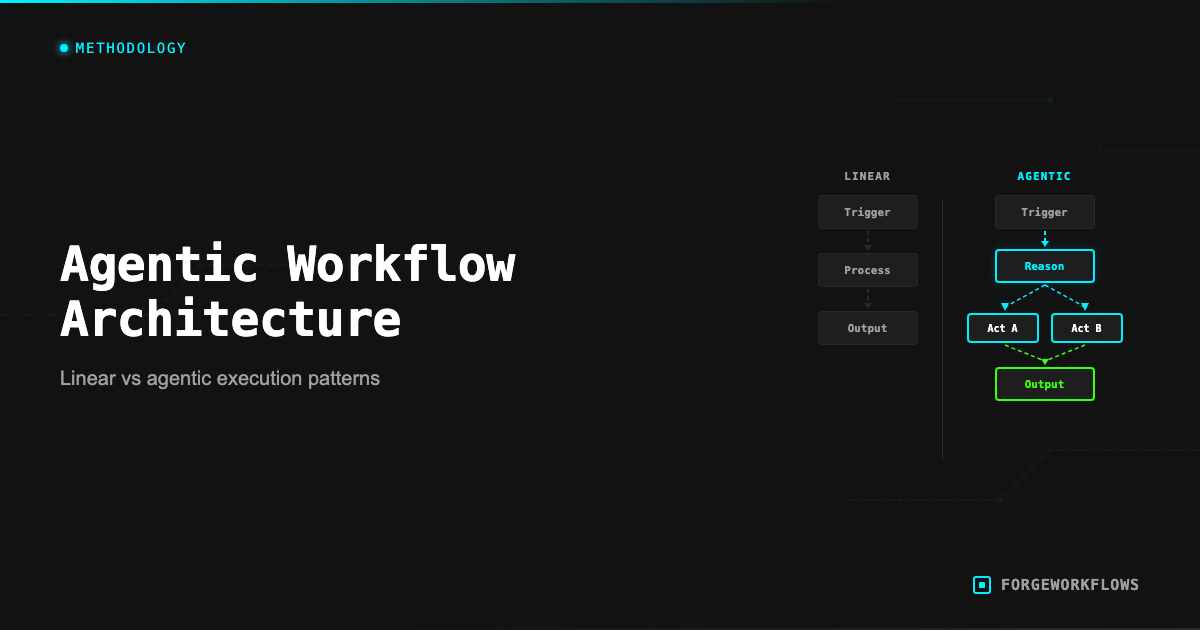
Linear automation follows a fixed path: trigger fires, step 1 runs, step 2 runs, step 3 runs, output is produced. The logic is deterministic in the most rigid sense - the same input always follows the same path through the same steps, regardless of context.
Classic examples of linear automation in B2B operations:
- "When a form is submitted, create a CRM contact, send a confirmation email, notify the sales channel."
- "When a deal moves to Closed Won, update the spreadsheet, send the success email, create the onboarding task."
- "Every Monday at 9am, pull the pipeline report from the CRM and post it to Slack."
These workflows are straightforward, reliable, and well-suited to the tools that defined the last decade of automation: Zapier, Make (Integromat), and early n8n workflows. They do not require judgment. They do not need to read nuance. They execute a fixed sequence.
Linear automation works well when the task is mechanical: move data from A to B, format it, send a notification. The moment a task requires interpretation - scoring a lead, analyzing a call transcript, diagnosing why a deal stalled - linear automation hits a wall.
What Is Agentic Logic
Agentic logic introduces reasoning into the automation pipeline. Instead of a fixed sequence of data-moving steps, an agentic pipeline includes one or more agent nodes that receive structured input, apply reasoning, and produce structured output.
An agent node is fundamentally different from a data-mapping node. A data-mapping node transforms field A into field B according to a rule you define. An agent node receives context, applies a reasoning-grade LLM with a specific system prompt, and produces output that reflects judgment - scoring, classification, analysis, recommendation, or generation.
In a ForgeWorkflows Blueprint, agents are organized as a modular swarm: each agent handles one phase of the pipeline, and the handoff between agents is deterministic. The agent output is structured (JSON with defined fields), not free-form text. This means downstream nodes can parse and route based on agent output, just like they would with data from an API call.
The key difference: linear automation asks "what steps should I execute?" Agentic logic asks "what should I conclude from this data, and what action does that conclusion warrant?" The first is a recipe. The second is a chain-of-thought.
Agentic does not mean autonomous. Every ForgeWorkflows Blueprint has a deterministic pipeline structure. Agents reason within their scope, but the pipeline architecture - which agent runs when, what data it receives, where its output goes - is fixed and auditable.
The Reasoning Gap
The gap between linear and agentic automation becomes clear when you look at tasks that require contextual judgment. Consider these real B2B workflow scenarios:
Scenario 1: Lead scoring. Linear approach: assign points based on form fields (job title = VP gets 20 points, company size > 500 gets 10 points). This works for basic segmentation but misses context. An agentic approach: the agent reads the form submission, researches the company, considers the combination of signals, and produces a score that reflects the overall picture - not just the sum of isolated field values.
Scenario 2: Deal stall diagnosis. Linear approach: "if days since last activity > 14, send a nudge email." This is a timer, not a diagnosis. An agentic approach: the agent reads the deal history, identifies the pattern (ghosting after pricing discussion vs. stall after champion left vs. stuck in legal review), and produces a specific diagnosis with a recommended action. The Deal Stall Diagnoser Blueprint does exactly this.
Scenario 3: Meeting preparation. Linear approach: pull the contact record from CRM and format it as a brief. You get a data dump. An agentic approach: the agent researches the attendee, analyzes their company activity, identifies relevant talking points, and generates an intelligence brief tailored to the specific meeting context. The Meeting Briefing Generator does this in a multi-agent pipeline.
In each case, the agentic approach produces output that a human would recognize as "useful analysis" - not just "data moved from point A to point B."
When Linear Is Fine
Agentic logic is not always the right choice. Linear automation remains the better option for many common B2B workflows:
- Data synchronization. Keeping two systems in sync (e.g., copying new HubSpot contacts to a Google Sheet) does not require reasoning. A simple trigger-and-map workflow is faster, cheaper, and more reliable.
- Notification routing. Sending a Slack message when a deal stage changes is a mechanical action. No judgment is needed - the event happened, the notification goes out.
- File processing. Converting a CSV to JSON, uploading to cloud storage, or reformatting data for import - these are data transformation tasks that are perfectly handled by linear pipelines.
- Simple conditional routing. "If deal value > $50K, route to enterprise sales; else route to SMB sales." The condition is binary and does not benefit from reasoning.
The test: if a task can be fully specified as a set of if/then rules that cover all cases, linear automation is sufficient. If the task requires reading context, weighing multiple factors, or producing analysis that would differ depending on the specific combination of inputs, agentic logic adds value.
Cost also matters. A linear workflow that moves data between systems costs nothing in LLM inference. An agentic workflow costs per execution (typically $0.01-$0.15 per run for ForgeWorkflows Blueprints). For high-volume, low-judgment tasks, the cost arithmetic favors linear.
Use linear automation for mechanical tasks (sync, notify, reformat). Use agentic logic for judgment tasks (score, analyze, diagnose, generate). Mixing both in the same pipeline is common and often the best approach.
When You Need Agents
Agentic logic becomes necessary when your workflow involves one or more of these characteristics:
- Multi-factor analysis. The output depends on the combination of many inputs, not just one field. Lead scoring that considers company size, job title, recent activity, technology stack, and competitive signals simultaneously is a multi-factor problem.
- Unstructured input. The workflow receives free-form text (emails, call transcripts, Slack messages, support tickets) and needs to extract structured meaning. This is inherently a reasoning task.
- Contextual recommendations. The workflow needs to suggest an action that depends on the specific situation. "Send a follow-up email" is generic; "Send a follow-up email referencing the pricing discussion on March 5th and the competitor mention" is contextual.
- Quality-sensitive output. The output is read by humans (executives, clients, prospects) and needs to be well-written, relevant, and accurate. Template-based outputs feel generic. Agent-generated outputs address the specific context.
ForgeWorkflows Blueprints address these scenarios with multi-agent pipelines. The Autonomous SDR uses a 32-node pipeline with multiple agents handling research, qualification, writing, and CRM synchronization. The RFP Intelligence + Response Agent uses agents for bid qualification, section analysis, and response generation. In both cases, the agentic architecture is what makes the output valuable - a linear pipeline could not produce the same quality. Every agentic Blueprint passes a BQS audit and is ITP-tested to verify that the multi-agent pipeline produces correct, consistent results.
Real-World Comparison
To make this concrete, here is a side-by-side comparison of a common B2B workflow implemented both ways:
Workflow: Process inbound demo request.
Linear approach:
- Webhook receives form submission.
- Create CRM contact with form fields.
- If company size > 100 employees, assign to enterprise queue.
- Send confirmation email (template).
- Post to #inbound-leads Slack channel with form data.
Time to implement: 30 minutes. Per-execution cost: $0 (no LLM calls). Output quality: data pass-through - no analysis.
Agentic approach (as in the Inbound Lead Qualifier):
- Webhook receives form submission.
- Agent 1 (Research): Looks up the company, identifies recent news, technology stack, growth signals.
- Agent 2 (Scoring): Scores the lead across multiple factors - not just company size, but fit, timing, intent signals, and competitive context.
- Agent 3 (Routing + Brief): Generates a qualification brief with the score, key insights, and recommended next steps. Routes based on the composite score.
- Output to CRM (enriched record) + Slack (intelligence brief).
Time to implement: 10 minutes (import + configure). Per-execution cost: ITP-measured (see product page). Output quality: scored, researched, and contextualized.
The linear version is faster and free. The agentic version tells the SDR who this person is, why they matter, and what to say when they call. Both have their place. The question is: which level of output does your team need?
For more on the quality standards behind ForgeWorkflows agentic pipelines, see What Is BQS? and How We Test Every Blueprint: The ITP Process.
Frequently Asked Questions
What is the difference between agentic logic and linear automation?+
Linear automation follows fixed if-this-then-that rules with no decision-making between steps. Agentic logic uses multi-step reasoning pipelines where agents evaluate context, score inputs, and route work dynamically based on the data they process.
When should a B2B team use linear automation instead of agentic workflows?+
Linear automation is the right choice for deterministic, high-volume tasks like data syncing, scheduled reports, or simple notifications. If the task requires no judgment or interpretation, a linear workflow is simpler and cheaper to run.
Do agentic workflows require more maintenance than linear ones?+
Not necessarily. Well-structured agentic workflows isolate their reasoning in system prompts and scoring thresholds, which are easy to tune. The underlying pipeline logic stays stable. ForgeWorkflows blueprints include error handling and retry logic that reduce ongoing maintenance.