Why B2B Teams Are Buying Workflows Instead of Building
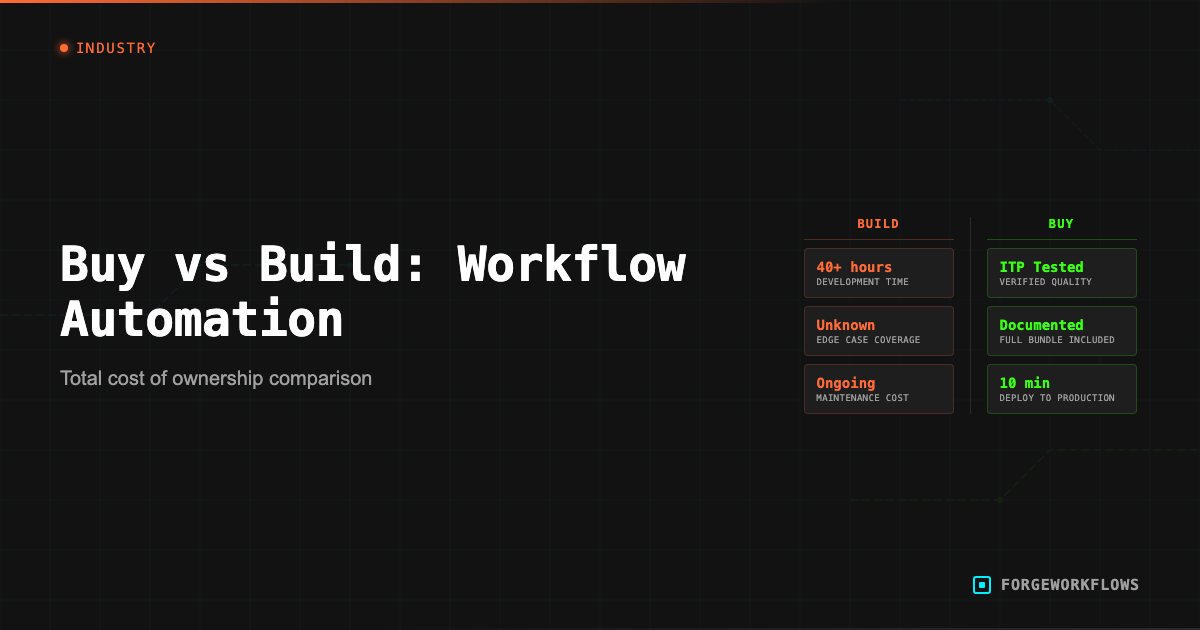
The Build vs. Buy Calculation
Every B2B operations team faces the same question when they need a new workflow: do we build it ourselves, or do we buy something pre-built? The default instinct - especially for teams with technical talent - is to build. "We know our process, we have n8n (or Zapier or Make), and we can build exactly what we need."
The build instinct is reasonable. But the calculation usually misses several cost categories that only appear after you have committed to building.
The visible cost of building: time to design the workflow, time to connect the integrations, time to test it. For a simple linear workflow, this might be 2-4 hours. For a multi-agent pipeline with reasoning, scoring, and routing, it is 20-40 hours - assuming you get the prompts right on the first try (you will not).
The invisible costs of building: prompt engineering iterations (getting an agent prompt to produce reliable, structured output takes multiple rounds of testing), error handling (what happens when the API is down? when the CRM returns empty data? when the model hallucinates?), documentation (so your teammate can maintain it when you are on vacation), and ongoing maintenance (when APIs change, when n8n updates, when your process evolves).
The cost of buying a ForgeWorkflows Blueprint: the listed price (one-time), plus 10 minutes to deploy. The prompt engineering, error handling, documentation, and testing are already done. The question is whether the price is less than the fully-loaded cost of building and maintaining the equivalent yourself.
What "Tested" Actually Means
When a vendor says their product is "tested," it could mean anything from "I ran it once and it did not crash" to "we have a comprehensive test suite with edge case coverage." The ambiguity is a problem, because the buyer cannot verify the claim without purchasing first.
ForgeWorkflows addresses this with two specific, documented testing protocols:
BQS (Blueprint Quality Standard) is a 12-point audit of the Blueprint files: workflow JSON validity, credential documentation, prompt completeness, error handling coverage, schema definitions, and README quality. It answers: "Is this Blueprint well-built and well-documented?"
ITP (Inspection and Test Plan) is functional testing with real API calls and structured test fixtures. It answers: "Does this Blueprint actually work correctly, and how much does it cost per execution?"
The ITP results are displayed on every product page. Per-execution cost is measured (not estimated). Test fixture record counts are stated. Milestone pass/fail results are documented. And the test fixtures are included in the bundle, so you can re-run the tests on your own instance to verify.
This is what "tested" means in the ForgeWorkflows context: audited structure + verified function + measured cost + reproducible results. If a Blueprint fails any of these, it does not ship.
BQS and ITP results are verifiable. The test fixtures are in your bundle. You can re-run them and compare against the published results. No trust required - just verification.
The Hidden Cost of DIY Workflows
Teams that choose to build often underestimate the total cost because they only count the initial development time. Here is what the full cost picture looks like for a typical multi-agent workflow built in-house:
Initial development: 20-40 hours. Design the pipeline, connect integrations, write agent prompts, build routing logic. This is the visible cost.
Prompt engineering: 10-20 hours. Getting an agent prompt to produce reliable, structured output is iterative work. The first prompt draft is rarely production-quality. You test, adjust, test again, handle edge cases, adjust again. For complex scoring or analysis agents, prompt engineering is the majority of the development effort.
Error handling: 5-10 hours. What happens when the CRM API is down? When the model returns malformed JSON? When the input record has null values in required fields? Each failure mode needs a handling path. Most DIY workflows skip this and discover the gaps in production - which costs more in lost time and broken data.
Documentation: 3-5 hours. You build the workflow. Can your colleague maintain it? Can they debug it when it fails at 2am? Without documentation, the workflow has a bus factor of 1.
Maintenance: 2-5 hours per month. APIs change. n8n updates. Your process evolves. The workflow that worked last quarter needs adjustments. This is the ongoing tax that never appears in the "should we build?" calculation.
Total first-year cost at a $75/hour loaded rate: $3,000-$6,000 for a single workflow. A ForgeWorkflows Blueprint covering the same scope costs $199-$349 one-time, with documentation, testing, and error handling already done.
When Building Makes Sense
Buying is not always the right answer. Building makes sense in these scenarios:
- Truly unique process. If your workflow is specific to your organization and no pre-built product exists that covers even 70% of the functionality, building is the only option. This is rare for common B2B operations workflows (lead scoring, deal analysis, meeting prep, CRM hygiene) but does happen for niche industry-specific processes.
- Learning investment. If your team is building workflow automation competency and wants to learn by doing, building a workflow from scratch is valuable educational experience. The cost is an investment in team capability, not just the workflow output.
- Simple linear workflows. For mechanical data-moving workflows (sync CRM to spreadsheet, send notification on event), building is fast, free of LLM costs, and does not benefit from the tested-and-documented approach that Blueprints provide.
- Rapid prototyping. If you need a quick proof of concept to validate that a workflow approach works before investing in a production version, a rough build is faster than evaluating and purchasing a product.
The common thread: building makes sense when the investment delivers value beyond the workflow itself (learning, uniqueness, speed of iteration), or when the workflow is simple enough that the build cost is trivially low.
When Buying Is the Clear Win
Buying a pre-built Blueprint is the clear win when:
- Time matters more than customization. You need the workflow running this week, not next month. A Blueprint deploys in 10 minutes. Building the equivalent takes weeks.
- Quality matters. You need the workflow to produce reliable, consistent output - not a prototype that works 80% of the time. BQS and ITP certification means the Blueprint has been audited and tested to a defined standard.
- You want documentation. Error handling matrices, deployment guides, schema definitions, and test fixtures are included. Building these from scratch is the most tedious part of workflow development.
- Cost transparency matters. ITP-measured per-execution costs mean you know what the workflow will cost to run before you buy it. DIY workflows reveal their cost profile only after deployment.
- The workflow is not your competitive advantage. Lead scoring, deal analysis, CRM hygiene, meeting prep - these are operational necessities, not differentiators. Spending 40 hours building a lead scorer does not give you a competitive edge over a team that bought one and deployed it in 10 minutes. Your edge comes from what you do with the output.
The Autonomous SDR (32-node pipeline, multiple agents, $297 one-time) would cost an estimated $4,000-$8,000 to build internally, accounting for prompt engineering, error handling, and documentation. The RFP Intelligence + Response Agent ($349 one-time) automates a process that typically takes a senior team member 4-6 hours per RFP. The math is not subtle.
Browse the full catalog at /blueprints. Every product page includes the dependency matrix, ITP-measured costs, and bundle contents so you can make the build-vs-buy calculation with complete information.
The build-vs-buy question is really a time-vs-money question. If your team operational cost is $75/hour, a $199 Blueprint pays for itself if it saves more than 2.7 hours of build time. Most save 20-40 hours.
Frequently Asked Questions
What are the hidden costs of building workflows in-house?+
Beyond developer hours, hidden costs include debugging edge cases discovered in production, maintaining prompt quality as models update, writing and updating documentation, and the opportunity cost of senior engineers building infrastructure instead of product. These costs compound over the workflow lifetime.
What does it mean that a workflow is tested before purchase?+
Every ForgeWorkflows blueprint passes a formal Inspection and Test Plan (ITP) with documented test fixtures and measured results. You can review the test outcomes on the product page before buying. This is not a demo or simulation — it is actual test data from real execution runs.
When does it make more sense to build a workflow internally?+
Building makes sense when your use case is highly proprietary, when the workflow is core IP for your business, or when no existing blueprint matches your requirements. For standard RevOps, sales intelligence, and CRM automation patterns, buying a tested blueprint typically saves weeks of development and testing time.